After some nagging from the parents, I'd realized going a whole week without posting an entry is just unacceptable. While I had been making some notes on what to write about, I had an experience today which skipped immediately to the forefront.
If you think of Spain, chances are bullfights are one of the first things to pop into your mind. I knew that while I was here, I just had to experience one. What others thought to be grotesque or inhumane, I have always excused for the benefit of tradition and culture. Since I was very young, I've been quite fond of animals (some may even say obsessed) but have never found enough reason to become vegetarian, join PETA or some other extreme ideology, detached from normal human behavior. In other words, I had been looking forward to witnessing the most reknowned Spanish sporting event. After rushing into Madrid by train, afraid we would miss the deadline for buying tickets, we bought the cheapest tickets (only 5E) expecting to have rather crappy seats. Ticket prices range from great seating to the nosebleed section, and come in two sides, sombra (shade) y sol (sun)...just another way to really understand the consitency and potency of the heat in Spain. Since the show started at 8:30pm, the sun was not a problem, and our 5E tickets turned out to be great seats.
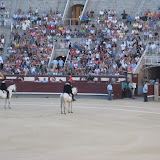
The taurino begins by a handful of matadores walking around the ring, preparing for the "show" (which, as I've come to understand, is its main purpose). Four or five novilleros (novice matadors) with bright pink capes chase the toro around the ring, as this is the point where the bull has the most energy, and I imagine, would be too much for only one matador. After several minutes, two men enter on horses which have been fully dressed in protective gear (on one side at least) and blindfolded (I expect horses wouldn't behave well around a charging bull). At some point shortly after this, the bull decides that the horse is some kind of threat--and rightly so. During the first show (there are four, at least; we left after three), the bull came to attack the horse, and of course, horse-lover that I am, got extremely nervous. The bull's horns and horse's gear were stained with red blood, and the horse fell to the ground, while the rider attempted to push the bull away with, what I had thought, was an ordinary stick. After several minutes of severe devastation and surprise of horse brutality, I realized that the blood belonged to the bull--not the horse, who had been adequately equipped to protect itself. I always feel more strongly for horses than people in movies, but in this scenario, I was extremely relieved that the horse had not been injured. Apparently those long, "prodding" devices wete extra long spears. From what I could tell, this was the first round, the first attempt to weaken the bull.
Several minutes pass, the horses and their riders leave the ring, and a few matadors taunt the bull. The next step is to weaken the bull even more. A matador approaches the bull, but with two, medium length poles, and when within a short enough distance, stabs the bull in the shoulders. This is repeated, how ever many times necessary to weaken the bull appropriately. In a short time, the bull, more angry but less competent than before--probably having something to do with the handful of short spears hanging from his neck--finds himself alone with the main matador. This is when the art of the show comes into play. The shows we watched were of novillades, the novice matadors, and the gracefulness and almost dance like quality to their movements made it easy to imagine how entertaining and beautiful a real, experienced matador would be to watch. It almost makes you forget about where you are and whats going on around you....
The last phase is with the main matador, who carries a red cape. The majority (and the most interesting) of the taunting takes place in this phase. El toro is its angriest here, but less capable, from my observation, to do any serious danger. Instead of running at the matador from the other side of the ring and charging, the dance (or shall I say fight?) between the two is closer...more intimate. After elegant swishing of the cape and some close escapes for the matador, he approaches the side of ring where a fellow matador hands him a thin sword, marking the beginning of the end for the bull. Once the bull is too weak to provide a decent battle (show?) for the audience, his time quickly runs down.When he is at a good distant, the matador artfully stabs the bull between the shoulders. The rest of the matadors join the ring, and within a few short minutes, the bull is on its knees, dies, and the show is over. In the end, a team of donkeys pull the bull out of the ring (to prepare for the next slaughter) by pulling it with a hook whipped into the bull--but not before the winning matador slices off an ear of the bull he mastered. He takes a victory lap around the ring, where spectators, showing their appreciation, throw their hats into the ring. The matador proudly holds up the ear to show his success, the crowd waves bags, paper or anything else white, seemingly to represent the "surrender" of the bull, although I'm not sure what its true meaning is. Then its on tto he next show, which starts in only a few minutes.
To be a fan of Spanish culture means having an appreciation for this age old art and sporting event. It was an experience of a lifetime--something I'll never forget. However, this experience was not without its occassional vomit-relfex or gut instinct that you were watching something unnatural and inhumane--especially when the matadors deliver their bloody blows to the bull's back. The whole process seems to be driven by entertainment...each phase progresses only when there is little left to see at the bull's weakness level. By no means am I an animal rights advocate (at least for animals we eat on a regular basis...), but bullfights are, without a doubt, too much. On top of the instinctual gut reflex, there are Spanish men yelling "Matalo ya" (Kill it already!) and other crude comments, as well as the idea that some Spanish people come to these every year, or several times a summer (they usually are only from spring to early fall)--merely for a good show. To kill your food is one thing, but to kill for sport and a good laugh over an empanada and a caña is something entirely different. In the end, I'm glad I saw it...but once in a lifetime is enough....or maybe even a bit too much.
(Pictures to come shortly...those with weak stomachs may want to steer clear of them, although I did try to avoid taking any pictures I would regret having later.)