Monday, July 26, 2010
Sunday, July 25, 2010
Matadors, matadors.
After some nagging from the parents, I'd realized going a whole week without posting an entry is just unacceptable. While I had been making some notes on what to write about, I had an experience today which skipped immediately to the forefront.
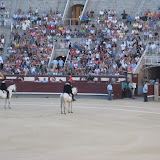
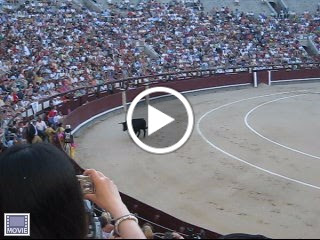
If you think of Spain, chances are bullfights are one of the first things to pop into your mind. I knew that while I was here, I just had to experience one. What others thought to be grotesque or inhumane, I have always excused for the benefit of tradition and culture. Since I was very young, I've been quite fond of animals (some may even say obsessed) but have never found enough reason to become vegetarian, join PETA or some other extreme ideology, detached from normal human behavior. In other words, I had been looking forward to witnessing the most reknowned Spanish sporting event. After rushing into Madrid by train, afraid we would miss the deadline for buying tickets, we bought the cheapest tickets (only 5E) expecting to have rather crappy seats. Ticket prices range from great seating to the nosebleed section, and come in two sides, sombra (shade) y sol (sun)...just another way to really understand the consitency and potency of the heat in Spain. Since the show started at 8:30pm, the sun was not a problem, and our 5E tickets turned out to be great seats.
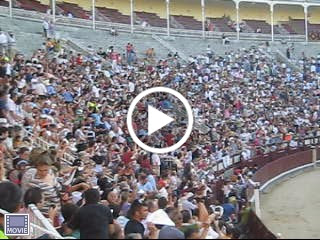
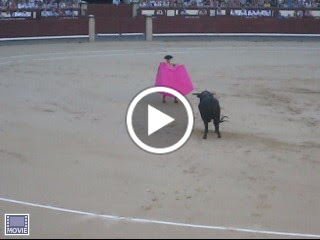
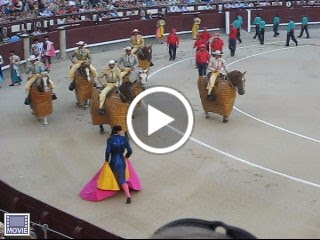
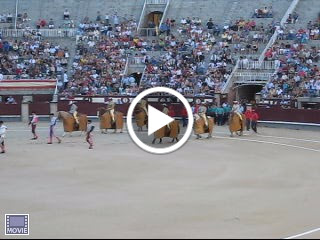
The taurino begins by a handful of matadores walking around the ring, preparing for the "show" (which, as I've come to understand, is its main purpose). Four or five novilleros (novice matadors) with bright pink capes chase the toro around the ring, as this is the point where the bull has the most energy, and I imagine, would be too much for only one matador. After several minutes, two men enter on horses which have been fully dressed in protective gear (on one side at least) and blindfolded (I expect horses wouldn't behave well around a charging bull). At some point shortly after this, the bull decides that the horse is some kind of threat--and rightly so. During the first show (there are four, at least; we left after three), the bull came to attack the horse, and of course, horse-lover that I am, got extremely nervous. The bull's horns and horse's gear were stained with red blood, and the horse fell to the ground, while the rider attempted to push the bull away with, what I had thought, was an ordinary stick. After several minutes of severe devastation and surprise of horse brutality, I realized that the blood belonged to the bull--not the horse, who had been adequately equipped to protect itself. I always feel more strongly for horses than people in movies, but in this scenario, I was extremely relieved that the horse had not been injured. Apparently those long, "prodding" devices wete extra long spears. From what I could tell, this was the first round, the first attempt to weaken the bull.
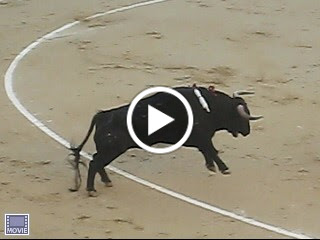
Several minutes pass, the horses and their riders leave the ring, and a few matadors taunt the bull. The next step is to weaken the bull even more. A matador approaches the bull, but with two, medium length poles, and when within a short enough distance, stabs the bull in the shoulders. This is repeated, how ever many times necessary to weaken the bull appropriately. In a short time, the bull, more angry but less competent than before--probably having something to do with the handful of short spears hanging from his neck--finds himself alone with the main matador. This is when the art of the show comes into play. The shows we watched were of novillades, the novice matadors, and the gracefulness and almost dance like quality to their movements made it easy to imagine how entertaining and beautiful a real, experienced matador would be to watch. It almost makes you forget about where you are and whats going on around you....
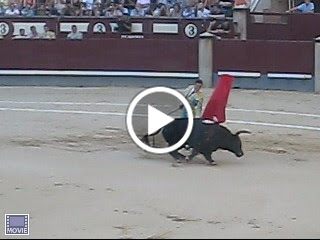
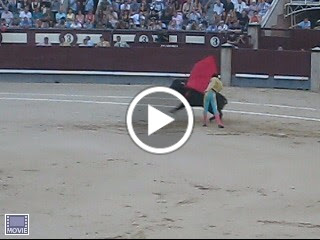
The last phase is with the main matador, who carries a red cape. The majority (and the most interesting) of the taunting takes place in this phase. El toro is its angriest here, but less capable, from my observation, to do any serious danger. Instead of running at the matador from the other side of the ring and charging, the dance (or shall I say fight?) between the two is closer...more intimate. After elegant swishing of the cape and some close escapes for the matador, he approaches the side of ring where a fellow matador hands him a thin sword, marking the beginning of the end for the bull. Once the bull is too weak to provide a decent battle (show?) for the audience, his time quickly runs down.When he is at a good distant, the matador artfully stabs the bull between the shoulders. The rest of the matadors join the ring, and within a few short minutes, the bull is on its knees, dies, and the show is over. In the end, a team of donkeys pull the bull out of the ring (to prepare for the next slaughter) by pulling it with a hook whipped into the bull--but not before the winning matador slices off an ear of the bull he mastered. He takes a victory lap around the ring, where spectators, showing their appreciation, throw their hats into the ring. The matador proudly holds up the ear to show his success, the crowd waves bags, paper or anything else white, seemingly to represent the "surrender" of the bull, although I'm not sure what its true meaning is. Then its on tto he next show, which starts in only a few minutes.
To be a fan of Spanish culture means having an appreciation for this age old art and sporting event. It was an experience of a lifetime--something I'll never forget. However, this experience was not without its occassional vomit-relfex or gut instinct that you were watching something unnatural and inhumane--especially when the matadors deliver their bloody blows to the bull's back. The whole process seems to be driven by entertainment...each phase progresses only when there is little left to see at the bull's weakness level. By no means am I an animal rights advocate (at least for animals we eat on a regular basis...), but bullfights are, without a doubt, too much. On top of the instinctual gut reflex, there are Spanish men yelling "Matalo ya" (Kill it already!) and other crude comments, as well as the idea that some Spanish people come to these every year, or several times a summer (they usually are only from spring to early fall)--merely for a good show. To kill your food is one thing, but to kill for sport and a good laugh over an empanada and a caña is something entirely different. In the end, I'm glad I saw it...but once in a lifetime is enough....or maybe even a bit too much.
(Pictures to come shortly...those with weak stomachs may want to steer clear of them, although I did try to avoid taking any pictures I would regret having later.)
If you think of Spain, chances are bullfights are one of the first things to pop into your mind. I knew that while I was here, I just had to experience one. What others thought to be grotesque or inhumane, I have always excused for the benefit of tradition and culture. Since I was very young, I've been quite fond of animals (some may even say obsessed) but have never found enough reason to become vegetarian, join PETA or some other extreme ideology, detached from normal human behavior. In other words, I had been looking forward to witnessing the most reknowned Spanish sporting event. After rushing into Madrid by train, afraid we would miss the deadline for buying tickets, we bought the cheapest tickets (only 5E) expecting to have rather crappy seats. Ticket prices range from great seating to the nosebleed section, and come in two sides, sombra (shade) y sol (sun)...just another way to really understand the consitency and potency of the heat in Spain. Since the show started at 8:30pm, the sun was not a problem, and our 5E tickets turned out to be great seats.
The taurino begins by a handful of matadores walking around the ring, preparing for the "show" (which, as I've come to understand, is its main purpose). Four or five novilleros (novice matadors) with bright pink capes chase the toro around the ring, as this is the point where the bull has the most energy, and I imagine, would be too much for only one matador. After several minutes, two men enter on horses which have been fully dressed in protective gear (on one side at least) and blindfolded (I expect horses wouldn't behave well around a charging bull). At some point shortly after this, the bull decides that the horse is some kind of threat--and rightly so. During the first show (there are four, at least; we left after three), the bull came to attack the horse, and of course, horse-lover that I am, got extremely nervous. The bull's horns and horse's gear were stained with red blood, and the horse fell to the ground, while the rider attempted to push the bull away with, what I had thought, was an ordinary stick. After several minutes of severe devastation and surprise of horse brutality, I realized that the blood belonged to the bull--not the horse, who had been adequately equipped to protect itself. I always feel more strongly for horses than people in movies, but in this scenario, I was extremely relieved that the horse had not been injured. Apparently those long, "prodding" devices wete extra long spears. From what I could tell, this was the first round, the first attempt to weaken the bull.
Several minutes pass, the horses and their riders leave the ring, and a few matadors taunt the bull. The next step is to weaken the bull even more. A matador approaches the bull, but with two, medium length poles, and when within a short enough distance, stabs the bull in the shoulders. This is repeated, how ever many times necessary to weaken the bull appropriately. In a short time, the bull, more angry but less competent than before--probably having something to do with the handful of short spears hanging from his neck--finds himself alone with the main matador. This is when the art of the show comes into play. The shows we watched were of novillades, the novice matadors, and the gracefulness and almost dance like quality to their movements made it easy to imagine how entertaining and beautiful a real, experienced matador would be to watch. It almost makes you forget about where you are and whats going on around you....
The last phase is with the main matador, who carries a red cape. The majority (and the most interesting) of the taunting takes place in this phase. El toro is its angriest here, but less capable, from my observation, to do any serious danger. Instead of running at the matador from the other side of the ring and charging, the dance (or shall I say fight?) between the two is closer...more intimate. After elegant swishing of the cape and some close escapes for the matador, he approaches the side of ring where a fellow matador hands him a thin sword, marking the beginning of the end for the bull. Once the bull is too weak to provide a decent battle (show?) for the audience, his time quickly runs down.When he is at a good distant, the matador artfully stabs the bull between the shoulders. The rest of the matadors join the ring, and within a few short minutes, the bull is on its knees, dies, and the show is over. In the end, a team of donkeys pull the bull out of the ring (to prepare for the next slaughter) by pulling it with a hook whipped into the bull--but not before the winning matador slices off an ear of the bull he mastered. He takes a victory lap around the ring, where spectators, showing their appreciation, throw their hats into the ring. The matador proudly holds up the ear to show his success, the crowd waves bags, paper or anything else white, seemingly to represent the "surrender" of the bull, although I'm not sure what its true meaning is. Then its on tto he next show, which starts in only a few minutes.
To be a fan of Spanish culture means having an appreciation for this age old art and sporting event. It was an experience of a lifetime--something I'll never forget. However, this experience was not without its occassional vomit-relfex or gut instinct that you were watching something unnatural and inhumane--especially when the matadors deliver their bloody blows to the bull's back. The whole process seems to be driven by entertainment...each phase progresses only when there is little left to see at the bull's weakness level. By no means am I an animal rights advocate (at least for animals we eat on a regular basis...), but bullfights are, without a doubt, too much. On top of the instinctual gut reflex, there are Spanish men yelling "Matalo ya" (Kill it already!) and other crude comments, as well as the idea that some Spanish people come to these every year, or several times a summer (they usually are only from spring to early fall)--merely for a good show. To kill your food is one thing, but to kill for sport and a good laugh over an empanada and a caña is something entirely different. In the end, I'm glad I saw it...but once in a lifetime is enough....or maybe even a bit too much.
(Pictures to come shortly...those with weak stomachs may want to steer clear of them, although I did try to avoid taking any pictures I would regret having later.)

Monday, July 19, 2010
My first taste of the Mediterranean
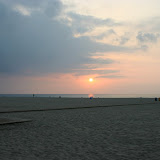
Valencia was full of experiences this weekend---good and bad. After a 4 hour trip by bus, in what was probably the most uncomfortable bus I've ever been in, we arrived in Valencia at 5am. I had planned out the way to the beach (30min walk, then the tram) so that we could watch the sunrise first thing in the morning. When we arrived to the beach, it was quite cloudy (I was just sure that instead of spending the weekend in "Sunny Valencia" as its known, it would be "Cloudy Valencia"...lucky I was proved wrong. After settling down on the beach, the others took a nap to finish the night of sleeping while I took my camera for some adventures. It was my first time to the Mediterranean coast, so I wanted to make sure I took home plenty of memories with me.
After everyone woke up, we headed to La Ciudad de las Artes y las Ciencias de Valencia--a complex of buildings, one of which is Oceanografik, Europe's largest aquarium. Of course I was dyeing of excitement because, if you didn't already know, my childhood dream was to become a whale trainer (something I blame on "Free Willy" and "Krats Kreatures")...and I'm still convinced that if at some point in my future I decide pharmacy is not for me, I'm moving to Orlando to play with whales. We had to use the tram and the bus to get to the aquarium, and this was the first time I realized that Valencia's public transport system left much to be desired. After asking a salesmen at the ticket office if I could use the same ticket for the bus and the tram (he said yes and was the rudest person I have encountered in Spain), the bus driver told us we couldn't us it. So then after figuring out how much it would cost, we made our way to the aquarium. I met some Americans in line for tickets who were studying in Toledo for 6 weeks; they were from Michigan and Ohio (I thought I had recognized a Minnesotan accent, but I guess I was a little off). It was nice to talk to some native speakers for a few minutes. The aquarium was tons of fun, and we got to watch a dolphin show as well. In all honesty, it wasn't anything I couldn't have done in the States, but it was still a blast (and I got some amazing pictures in the mean time).
After the aquarium, we made our way back to the center of Valencia, and I had my first paella experience. I've been waiting yeeearrs to have a REAL paella experience. And it was absolutely delicious. I had expected paella valenciana to be made with seafood, but surprisingly the most typical paella from Valencia is with beans and chicken. It tasted better than I had imagined and definitely reminded me of how much saffron I need to bring back from Spain (since its sooo expensive in the US). I also tasted the iconic drink of Valenica, Agua de Valencia, which is something along the lines of orange juice, champagne, gin and vodka. Deliciosa. I went to check into my hostel while the others got settled on the beach. They wanted to sleep on the beach, and my better judgement had told me not to. Plus some advice from relatives and friends...particularly from Carrie, my best friend who studied in Sevilla for a semester. She told me that Valencia wasn't that safe of a city, so it confirmed my previous decision. Luckily, nothing happened to my friends while they slept on the beach, but for the safety of mind (comfort and shower), it was well worth the 20 bucks.
Then we went to party on the beach and tried to visit the center to watch Flamenco in La Plaza de la Virgen....but unfortunatley, at that moment we had our second bad encounter with the tram system. We had missed the last tram to the center (because the schedules are so poorly shown at the stations), tried to take another line that brought us close enough to the center, but we ended up at a dead end and went back to where we started, with not enough time to make it to the show. We decided to stay on the beach and have a good time, which ended up being plenty of fun on its own. This is when I realized that Valencia is the most romantic city, by night, that I have ever been to. Palm trees, warm breezes, spanish guitar, soft lighting, the smell of gypsies roasting corn on the cob, and being surrounded my crowds murmurring slowly in Spanish. One great thing that I'll always appreciate about South(ern) Spain is how much slower they speak. I can't help but think about the slowness in which Southerners from the US speak as compared to the Northerners. In Valencia, they are much easier to understand, and now I can't wait to visit the real Southern Spain, Andalucia, in August.
Valencia also recognizes the language Valenciano, which is a dialect of Catalan, a language very simlar to Spanish and French and gets most recognition in Barcelona. I was interested to see that most every street sign, advertisement, public notice, and menu includes Valenciano, while I heard no one speaking it. Igor and I both asked taxi drivers on separate occasions if anyone from Valencia actually spoke Valenciano. They said that everyone speaks Spanish and everyone understands Valenciano, but neither of them knew what percentage actually speaks it. In Spain, keeping the distinct languages of each region is very important, but I can't imagine keeping a language alive if no one speaks it..seems fruitless in my opinion.
Saturday night we spent partying on the beaches, and Sunday was spent for sightseeing. Zuza and myself went on a tour of the Cathedral, which houses what many consider to be The Holy Grail. It was incredibly intersting to me to be in the prescence of something that Jesus himself was even believed to have touched. Absolutely amazing. We also trekked through El Barrio del Carmen, but as it was Sunday at siesta time...there was little to see. This area is the culture, bohemian center of the youthful Valencia at night, but during the day seems much like a ghost town. For the rest of the day, we relaxed and sunbathed on the beach. I was surprised to see that it was topless beach (not nude...just topless) and that any girl from the age of 2 to 82 feels comfortable going topless. It was definitely an experience for me, but it was easy to get used to. The Spanish seem to be very comfortable with themselves, and toplessness seems to be something to you do out of comfort and not sexuality. After a nice walk along the very crowded beaches, I browsed the gypsy market along the beach and enjoyed some paella del marisco (seafood paella), since it seems to be the most "ideal paella" in the States. It was absolutely delicious, even though I had to enjoy it by myself...no one else cared for seafood enough to join me in the restaurant. Even though I'm unafraid to dine alone, even in the States, it was fairly obvious that this is not common practice in Spain (who dine mostly to converse with friends and family) as everyone seemed to think I was crazy. However, I wasn't about to let some sensitive stomach'ed Europeans keep me from my paella del marisco experience.
The last and most frustrating experience with Valencia's public transport system was Sunday evening. We missed the last tram to the center, although I had asked a gentleman on the tram if it would pass through Pont de Fusta (our stop) and he said yes. Unfortunately we ended up at a station where we had no idea where we were, with only an hour before our bus departure. Luckily, I had written down two numbers for taxis in Valencia. I called one, asked for two taxis for seven people, and only one showed up. After frantically deciding what to do with the remaining four after the other three had headed off to the train station, I called the other taxi number for a second. Ester (one of the Hungarian girls) and Oliwer (Polish guy) wanted to ask a stranger to take us to the station in his car, but once again my better judgement stepped in to say "Nooo I prefer if we didn't." I think both of them were extremely agitated with me and thought we would miss the bus by the time the second cab came. I told him we were in a hurry to catch a bus and asked if there was plenty of time, and he assured me that there was. Luckily, we made it to the bus station with about 30 minutes to spare, but the whole public transport experience in Valencia definitely made me realize that over-preparation is nothing to scoff at....Everyone was extremely thankful for my attention to detail and preparedness on this trip. My new motto for travelling abroad is "When in doubt, write it out"....
*Just a side note: Most Europeans eat pizza with ketchup. They were all quite surprised when I told them that I had never seen anyone eat pizza like that. Gross. I guess pizza is more famous in America for a reason.....
After everyone woke up, we headed to La Ciudad de las Artes y las Ciencias de Valencia--a complex of buildings, one of which is Oceanografik, Europe's largest aquarium. Of course I was dyeing of excitement because, if you didn't already know, my childhood dream was to become a whale trainer (something I blame on "Free Willy" and "Krats Kreatures")...and I'm still convinced that if at some point in my future I decide pharmacy is not for me, I'm moving to Orlando to play with whales. We had to use the tram and the bus to get to the aquarium, and this was the first time I realized that Valencia's public transport system left much to be desired. After asking a salesmen at the ticket office if I could use the same ticket for the bus and the tram (he said yes and was the rudest person I have encountered in Spain), the bus driver told us we couldn't us it. So then after figuring out how much it would cost, we made our way to the aquarium. I met some Americans in line for tickets who were studying in Toledo for 6 weeks; they were from Michigan and Ohio (I thought I had recognized a Minnesotan accent, but I guess I was a little off). It was nice to talk to some native speakers for a few minutes. The aquarium was tons of fun, and we got to watch a dolphin show as well. In all honesty, it wasn't anything I couldn't have done in the States, but it was still a blast (and I got some amazing pictures in the mean time).
After the aquarium, we made our way back to the center of Valencia, and I had my first paella experience. I've been waiting yeeearrs to have a REAL paella experience. And it was absolutely delicious. I had expected paella valenciana to be made with seafood, but surprisingly the most typical paella from Valencia is with beans and chicken. It tasted better than I had imagined and definitely reminded me of how much saffron I need to bring back from Spain (since its sooo expensive in the US). I also tasted the iconic drink of Valenica, Agua de Valencia, which is something along the lines of orange juice, champagne, gin and vodka. Deliciosa. I went to check into my hostel while the others got settled on the beach. They wanted to sleep on the beach, and my better judgement had told me not to. Plus some advice from relatives and friends...particularly from Carrie, my best friend who studied in Sevilla for a semester. She told me that Valencia wasn't that safe of a city, so it confirmed my previous decision. Luckily, nothing happened to my friends while they slept on the beach, but for the safety of mind (comfort and shower), it was well worth the 20 bucks.
Then we went to party on the beach and tried to visit the center to watch Flamenco in La Plaza de la Virgen....but unfortunatley, at that moment we had our second bad encounter with the tram system. We had missed the last tram to the center (because the schedules are so poorly shown at the stations), tried to take another line that brought us close enough to the center, but we ended up at a dead end and went back to where we started, with not enough time to make it to the show. We decided to stay on the beach and have a good time, which ended up being plenty of fun on its own. This is when I realized that Valencia is the most romantic city, by night, that I have ever been to. Palm trees, warm breezes, spanish guitar, soft lighting, the smell of gypsies roasting corn on the cob, and being surrounded my crowds murmurring slowly in Spanish. One great thing that I'll always appreciate about South(ern) Spain is how much slower they speak. I can't help but think about the slowness in which Southerners from the US speak as compared to the Northerners. In Valencia, they are much easier to understand, and now I can't wait to visit the real Southern Spain, Andalucia, in August.
Valencia also recognizes the language Valenciano, which is a dialect of Catalan, a language very simlar to Spanish and French and gets most recognition in Barcelona. I was interested to see that most every street sign, advertisement, public notice, and menu includes Valenciano, while I heard no one speaking it. Igor and I both asked taxi drivers on separate occasions if anyone from Valencia actually spoke Valenciano. They said that everyone speaks Spanish and everyone understands Valenciano, but neither of them knew what percentage actually speaks it. In Spain, keeping the distinct languages of each region is very important, but I can't imagine keeping a language alive if no one speaks it..seems fruitless in my opinion.
Saturday night we spent partying on the beaches, and Sunday was spent for sightseeing. Zuza and myself went on a tour of the Cathedral, which houses what many consider to be The Holy Grail. It was incredibly intersting to me to be in the prescence of something that Jesus himself was even believed to have touched. Absolutely amazing. We also trekked through El Barrio del Carmen, but as it was Sunday at siesta time...there was little to see. This area is the culture, bohemian center of the youthful Valencia at night, but during the day seems much like a ghost town. For the rest of the day, we relaxed and sunbathed on the beach. I was surprised to see that it was topless beach (not nude...just topless) and that any girl from the age of 2 to 82 feels comfortable going topless. It was definitely an experience for me, but it was easy to get used to. The Spanish seem to be very comfortable with themselves, and toplessness seems to be something to you do out of comfort and not sexuality. After a nice walk along the very crowded beaches, I browsed the gypsy market along the beach and enjoyed some paella del marisco (seafood paella), since it seems to be the most "ideal paella" in the States. It was absolutely delicious, even though I had to enjoy it by myself...no one else cared for seafood enough to join me in the restaurant. Even though I'm unafraid to dine alone, even in the States, it was fairly obvious that this is not common practice in Spain (who dine mostly to converse with friends and family) as everyone seemed to think I was crazy. However, I wasn't about to let some sensitive stomach'ed Europeans keep me from my paella del marisco experience.
The last and most frustrating experience with Valencia's public transport system was Sunday evening. We missed the last tram to the center, although I had asked a gentleman on the tram if it would pass through Pont de Fusta (our stop) and he said yes. Unfortunately we ended up at a station where we had no idea where we were, with only an hour before our bus departure. Luckily, I had written down two numbers for taxis in Valencia. I called one, asked for two taxis for seven people, and only one showed up. After frantically deciding what to do with the remaining four after the other three had headed off to the train station, I called the other taxi number for a second. Ester (one of the Hungarian girls) and Oliwer (Polish guy) wanted to ask a stranger to take us to the station in his car, but once again my better judgement stepped in to say "Nooo I prefer if we didn't." I think both of them were extremely agitated with me and thought we would miss the bus by the time the second cab came. I told him we were in a hurry to catch a bus and asked if there was plenty of time, and he assured me that there was. Luckily, we made it to the bus station with about 30 minutes to spare, but the whole public transport experience in Valencia definitely made me realize that over-preparation is nothing to scoff at....Everyone was extremely thankful for my attention to detail and preparedness on this trip. My new motto for travelling abroad is "When in doubt, write it out"....
*Just a side note: Most Europeans eat pizza with ketchup. They were all quite surprised when I told them that I had never seen anyone eat pizza like that. Gross. I guess pizza is more famous in America for a reason.....
Wednesday, July 14, 2010
The Game of Lifetime
So Spain won the World Cup in soccer (which you should know already, unless you've been living under a rock) on Sunday evening, and we all went to Madrid to watch the game at the public viewing in La Plaza de Cibeles. It was amazing. Just like in Germany, its really uncommon to see the Spanish with such patriotism, but for very different reasons. There tends to be more pride for the autonomous community than for Spain, a result of years of oppression and cohesiveness forced upon them by Franco in the last century. Under his rule, only Spanish was allowed to be spoken while the languages and cultures of the different regions in Spain (specifically, the Basque country with Vasco, Cataluña with Catalan, and Galicia with Gallego). After Franco, everyone was so relieved to be able to support their specific heritage and culture that pride for their autonomous community was overwhelming. Meanwhile, they generally avoided pride for Spain as a whole as it reminded them of Franco, when they were forced to be "one spain" (the motto during his rule was "Una, Grande, Libre"---"One, Great, Free"). Spain has an incredibly interesting and complex history, demonstrated here, which is one of the main reasons I'm drawn to the country and its people.
During the final match, everyone forgot all about these formalities and for a change, they were one Spain again. It was incredible to witness something so rare, and I can't believe I was so luck to be here when they won their first World Cup. Before I left the States, I hoped I would be able to watch at least one game...never did I imagine it would come to this. If there is one thing I've experienced more of in Spain than anywhere else, its how to maneuver in HUGE crowds; La Plaza de Cibeles and Pamplona were crazy enough, but at the end of the match we had to leave in order to catch the last train back to Alcalá (or else be stuck in Madrid the whole night, which could have been amazing or awful, who's to say). Fighting through the crowd as everyone was trying to watch the team accept the trophy was nearly impossible. I've never been more squished in my entire life, but I led the group through it as best I could (there is just something about those situations where I have to be in control or I get verrrry frustrated). Even after we'd navigated our way through the mass of people, running against the grain to the train station proved to be just as difficult. Luckily we made it in time for the train---with only three minutes to spare.
I'll never forget the celebrations that night, or the next night, or the night after that. In fact, there is still some celebrating going on outside my window in Alcalá right now...
During the final match, everyone forgot all about these formalities and for a change, they were one Spain again. It was incredible to witness something so rare, and I can't believe I was so luck to be here when they won their first World Cup. Before I left the States, I hoped I would be able to watch at least one game...never did I imagine it would come to this. If there is one thing I've experienced more of in Spain than anywhere else, its how to maneuver in HUGE crowds; La Plaza de Cibeles and Pamplona were crazy enough, but at the end of the match we had to leave in order to catch the last train back to Alcalá (or else be stuck in Madrid the whole night, which could have been amazing or awful, who's to say). Fighting through the crowd as everyone was trying to watch the team accept the trophy was nearly impossible. I've never been more squished in my entire life, but I led the group through it as best I could (there is just something about those situations where I have to be in control or I get verrrry frustrated). Even after we'd navigated our way through the mass of people, running against the grain to the train station proved to be just as difficult. Luckily we made it in time for the train---with only three minutes to spare.
I'll never forget the celebrations that night, or the next night, or the night after that. In fact, there is still some celebrating going on outside my window in Alcalá right now...
Monday, July 12, 2010


Los Sanfermines en Pamplona
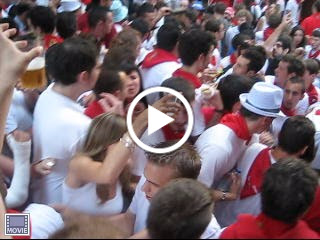
Wow this past weekend has definitely been one to remember! On Friday evening, six of us went the crrrrazy festival, los Sanfermines, in Pamplona. The most popular activity in the festival is el encierro, or the running of the bulls. Its usually attempted by los borrachos (drunks) who have "drunk muscles" at 8am. We arrived in two different shifts; Dejan, Igor and I arrived at about 2am after around 5 hours on a bus (or at a bus station), while Susannah, Oliver and Anna (the Polish crowd) left later and arrived at 3:30am. I expected there to be plenty of people still up from a night of partying, and we planned on joining them until the encierro at 8am (finding a hostel at the last minute in Pamplona is nearly impossible and would cost us allll of our arms and legs). However---I was not nearly expecting what we found. Hundreds upon hundreds of people were partying at full force throughout the night. We took a wrong turn into the streets where all the most happening clubs were located, and I never thought we would get out. Literally we just pushed ourselves (and other people) through the crowd. The streets and parks were full of trash; the Spanish are always well prepared to drink--most of them brought coolers with ice, wine and coke (for the kalimotxos) and left the trash right where they were (I imagine if this were Germany the bums would be loving all the free cash on the ground!). The worst about the whole thing was that the streets reeked of urine. All the streets were wet, and I preferred to imagine it was beer or kalimotxo, but as we walked down la Calle Estafeta (where we wanted to post up to watch the encierro) I could no longer ignore the obvious---within three blocks, there were at least 5 men peeing on the streets. And even though the streets were almost completely clean by 2pm that day (swept and watered down), there was still the distinct and overwhelming stench of hot piss. Quite disturbing.
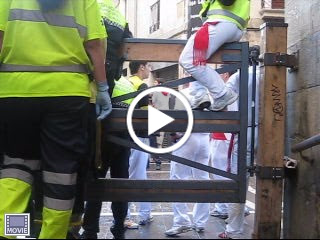
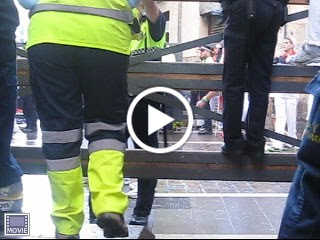
We took our places sitting on a fence on la Calle Estafeta at about 6:30am, which is when most sources said you have to get there in order to even see the encierro. The streets became soo unbelievably crowded again (I was glad to be perched safely above it), then the street was cleaned and people were pushed out of the streets into the alleys. Unfortunately, even though we were right behind the fence which by now had been closed, we still didn't have a good view. There are three main areas to see the encierro--at the beginning where they run from one street into la Calle de Estafeta (dangerous because if the bulls are running fast, they can run into the sides), la Calle de Estafeta (not along the whole street, but only at intersections with other streets---this is where we were) and then where Estafeta runs into the la plaza de torros (the bullring, where the bullfights take place at 6m every evening of the festival--dangerous because of the slope or the path). We chose the safest place along Estafeta, but there were two fences between us and the street where police and emergency personnel stood. Needless to say, we didn't have a good view. I'd have to say that the encierro itself was pretty boring--I assume only maybe 2 out out of the 8 encierros during the festival every year get exciting (with angry bulls or rreally drunk runners). Witnessing the festivities was much more entertaining than the four minutes of watching people jog with some bulls. Either way, it was a blast, and I'm sooo glad to have visited one of the best parties in the world (probably of the same caliber as Mardi Gras or Carnival in Rio de Janerio---its all about letting loose and getting crazy). And it was well worth the trip.
We took our places sitting on a fence on la Calle Estafeta at about 6:30am, which is when most sources said you have to get there in order to even see the encierro. The streets became soo unbelievably crowded again (I was glad to be perched safely above it), then the street was cleaned and people were pushed out of the streets into the alleys. Unfortunately, even though we were right behind the fence which by now had been closed, we still didn't have a good view. There are three main areas to see the encierro--at the beginning where they run from one street into la Calle de Estafeta (dangerous because if the bulls are running fast, they can run into the sides), la Calle de Estafeta (not along the whole street, but only at intersections with other streets---this is where we were) and then where Estafeta runs into the la plaza de torros (the bullring, where the bullfights take place at 6m every evening of the festival--dangerous because of the slope or the path). We chose the safest place along Estafeta, but there were two fences between us and the street where police and emergency personnel stood. Needless to say, we didn't have a good view. I'd have to say that the encierro itself was pretty boring--I assume only maybe 2 out out of the 8 encierros during the festival every year get exciting (with angry bulls or rreally drunk runners). Witnessing the festivities was much more entertaining than the four minutes of watching people jog with some bulls. Either way, it was a blast, and I'm sooo glad to have visited one of the best parties in the world (probably of the same caliber as Mardi Gras or Carnival in Rio de Janerio---its all about letting loose and getting crazy). And it was well worth the trip.
Thursday, July 8, 2010
La Farmacia de Goya
I've spent almost a whole work week at the pharmacy now (if you count 4 hours a day a "work week," and so far I've learned quite a bit about pharmacy in Spain--although there is a lot I don't know. Since Elena is now at the IPSF congress in Serbia (or maybe she's doing an exchange?? I'm not exactly sure..), the pharmacy is the only place I hear a lot of Spanish. At times, its just too overwhelming. I generally understand everything the pharmacists tell me to do, but they are an extremely busy pharmacy right now; as they've explained it, they have a lot of pharmacists on vacation because its summer. So although I'd like to ask lots of questions to learn more and practice my Spanish, usually there's not enough time. Also, the pharmacy is connected to Dr. Goya's office, so there is a lot of business (patients done with their appointments walk right through the back of the pharmacy to the front door!! Thats one thing that would never happen in the States! HIPAA violations--although there is no real patient information to see, I'll tell you about it later) I only stay in the back--talking to patients is still overwhelming to me since madrileños speak soooo fast. Even when the pharmacists speak to each other, I don't understand most of it. After putting away the order, I pretty much just stand around until they have something for me to do. I'll get some medications for them or take out the trash---when I get really bored I just organize the generic meds and look at all the stuff they keep there. Its not exactly what I expected, but I'm still learning--and its only the first week, maybe things will get more exciting soon.
There are several big differences I've noticed so far. There is absolutely no counting of pills. Everything is prepackaged in counts of 10, 12, 20, 28, 30, 60 or 100, depending on the medications. There is also no real computer system--no patint profiles, no allergies listed, no patient information in general. Since they don't really have a private insurance business, computers are not as important I suppose (I guess medications are all just really cheap?? not sure, haven't figured out the details yet). The only way they know if they've given a medication to someone is by cutting off the barcode and taping it to the prescription. Which leads me to another point. There are no labels--so the patients literally just get a box saying what the medication is and (I suppose) the regular directions for adminstration. The directions written by the doctor are on the prescription, but the pharmacy keeps those. For me, it sends up a red flag. It seems like this system relies completely on patient compliance and the good ole' trust system. In the States the labels have everything--prescription number (I don't think they have such a thing as "refills" here), prescribing doctor, pharmacy, pharmacist initials, directions, date filled...everything. Also, what if there is a confusing dosing that is patient specific? I'm still trying to figure these things out. Something that seems weird to me is that male and female pharmacists have different uniforms. Males have lab coats like in the States, while women wear what looks more like scrubs--and I think nurses wear the exact same thing. Oh yeah---there are NO pharmacy technicians. Everyone in the pharmacy is a pharmacist, so there is no final check. You get the prescription, you go to drawer, get the box, take it to the register and check them out. Quite different.
I'm also not quite sure yet how the controlled medications work. I've seen Concerta (Schedule 2--we have to monitor pretty much everything with this in the States) is in a regular drawer. But we did get Oxycontin in an order today, and I think there is a special place for it because it wasn't in the drawer later where it would've been. I'll have to ask about it soon---you know, when there are 2 minutes to spare. Many of the brand names are the same, while some are different or very similar. Generic names are the same except with A's or O's on the end of them, plus the manufactures name. For instance, you might see Simvistatina SANDOZ right next to Simvistatina MYLAN. Another thing that I think is quite common throughout Europe is that aspirin is still the most popular anti-inflammatory, analgesic and NSAID. From what I can tell, ibuprofen is only available with prescription. In the states, aspirin is primarily used for blood thinning, anti-coagulation purposes, while its analgesic use is pretty uncommon. I'm interested to learn more about why this is so different--I haven't even seen any Tylenol yet! I hope to learn more about their system in the next few weeks, because there is still a lot to learn.
There are several big differences I've noticed so far. There is absolutely no counting of pills. Everything is prepackaged in counts of 10, 12, 20, 28, 30, 60 or 100, depending on the medications. There is also no real computer system--no patint profiles, no allergies listed, no patient information in general. Since they don't really have a private insurance business, computers are not as important I suppose (I guess medications are all just really cheap?? not sure, haven't figured out the details yet). The only way they know if they've given a medication to someone is by cutting off the barcode and taping it to the prescription. Which leads me to another point. There are no labels--so the patients literally just get a box saying what the medication is and (I suppose) the regular directions for adminstration. The directions written by the doctor are on the prescription, but the pharmacy keeps those. For me, it sends up a red flag. It seems like this system relies completely on patient compliance and the good ole' trust system. In the States the labels have everything--prescription number (I don't think they have such a thing as "refills" here), prescribing doctor, pharmacy, pharmacist initials, directions, date filled...everything. Also, what if there is a confusing dosing that is patient specific? I'm still trying to figure these things out. Something that seems weird to me is that male and female pharmacists have different uniforms. Males have lab coats like in the States, while women wear what looks more like scrubs--and I think nurses wear the exact same thing. Oh yeah---there are NO pharmacy technicians. Everyone in the pharmacy is a pharmacist, so there is no final check. You get the prescription, you go to drawer, get the box, take it to the register and check them out. Quite different.
I'm also not quite sure yet how the controlled medications work. I've seen Concerta (Schedule 2--we have to monitor pretty much everything with this in the States) is in a regular drawer. But we did get Oxycontin in an order today, and I think there is a special place for it because it wasn't in the drawer later where it would've been. I'll have to ask about it soon---you know, when there are 2 minutes to spare. Many of the brand names are the same, while some are different or very similar. Generic names are the same except with A's or O's on the end of them, plus the manufactures name. For instance, you might see Simvistatina SANDOZ right next to Simvistatina MYLAN. Another thing that I think is quite common throughout Europe is that aspirin is still the most popular anti-inflammatory, analgesic and NSAID. From what I can tell, ibuprofen is only available with prescription. In the states, aspirin is primarily used for blood thinning, anti-coagulation purposes, while its analgesic use is pretty uncommon. I'm interested to learn more about why this is so different--I haven't even seen any Tylenol yet! I hope to learn more about their system in the next few weeks, because there is still a lot to learn.
Villa, Ramos, Velazquez and El Greco...Spain at its finest.
Well, you'd have to be living under a rock if you didn't know that Spain is in the championship for the World Cup--they're very first time in the finals. The match is this Sunday and we are all planning on going to La Plaza de Cibeles for a public viewing of the game after a day of tapas and canas with Carlos. Spain has already surprised me thus far, so I can't even imagine what Madrid will look like if they become World Champions! We watched the game last night in the same bar in Sol, the heart of Madrid, and it was an absolute riot. I loved seeing Madrid so alive and full of people. The metro and the campus was alive and full of people. In fact, I had a hard time falling asleep thanks to the chanting and partying going on outside my window. But its worth having a couple bad nights of sleeping for this once in a lifetime experience. All I can say is its perfect timing to be here :) As my Dad pointed out, I have visited 3 out of 4 countries in the semifinals---I think I am good luck to all this futbol. Soooo Viva Espana!
Before watching the game last night we visited El Museo del Prado in Madrid. It took over 2 hours to walk through, and after I saw my favorite Spanish artists, I was pretty much done with the whole thing. I had studied Spanish artists in my Culture of Spain class in undergrad and fell in love with Diego Velazquez. His art is very life-like, and even though its very realistic and naturalistic, he finds ways to make them interesting (like painting himself into them or adding unexpected dimensions). Most of his counterparts during the 17th century did mostly mythological and religous pieces, but Velazquez was invited to be part of the court for Felipe IV, so he did many royal paintings. My favorites from him are: "Las Meninas" (has many dimensions, interesting additions---like a puzzle everytime you look at it. I probably stood in front of it for a good 30 minutes), "Los Borrachos" (the drunks), "La Crucifición" (The crucifixion of Christ--usually once you've seen so many of these you've seen them all, but his is really brilliant and stands out above the rest in my opinion), and "La Rendición de Breda" (The surrender of Breda, where he painted himself, perhaps several times, into the crowds of Spaniards and the Dutch after a war---coincidence??) I was also looking forward to seeing Goya but was honestly not impressed by him. I was very impressed with El Greco, however, which was very unexpected. I especially loved his "loose hand" period, where instead of everything having very smooth lines, they're more jagged. It may seem more unrealistic to many, but to me its more real. Amongst so many other religous paintings, his six paintings from the "Retablo Mayor" stand out as elegant, moving, and focused (even though each is full of different images, there is still a focus--thats what I enjoy most about them). Visiting The Prado made me so much more excited to visit El Centro de Arte Reina Sofia, where works of more modern Spanish artists are. Ones I'm thrilled to see are Dalí, Picasso and Miro---AND this museum is home to "Guernica." I'll probably spend an hour in front of it....
Before watching the game last night we visited El Museo del Prado in Madrid. It took over 2 hours to walk through, and after I saw my favorite Spanish artists, I was pretty much done with the whole thing. I had studied Spanish artists in my Culture of Spain class in undergrad and fell in love with Diego Velazquez. His art is very life-like, and even though its very realistic and naturalistic, he finds ways to make them interesting (like painting himself into them or adding unexpected dimensions). Most of his counterparts during the 17th century did mostly mythological and religous pieces, but Velazquez was invited to be part of the court for Felipe IV, so he did many royal paintings. My favorites from him are: "Las Meninas" (has many dimensions, interesting additions---like a puzzle everytime you look at it. I probably stood in front of it for a good 30 minutes), "Los Borrachos" (the drunks), "La Crucifición" (The crucifixion of Christ--usually once you've seen so many of these you've seen them all, but his is really brilliant and stands out above the rest in my opinion), and "La Rendición de Breda" (The surrender of Breda, where he painted himself, perhaps several times, into the crowds of Spaniards and the Dutch after a war---coincidence??) I was also looking forward to seeing Goya but was honestly not impressed by him. I was very impressed with El Greco, however, which was very unexpected. I especially loved his "loose hand" period, where instead of everything having very smooth lines, they're more jagged. It may seem more unrealistic to many, but to me its more real. Amongst so many other religous paintings, his six paintings from the "Retablo Mayor" stand out as elegant, moving, and focused (even though each is full of different images, there is still a focus--thats what I enjoy most about them). Visiting The Prado made me so much more excited to visit El Centro de Arte Reina Sofia, where works of more modern Spanish artists are. Ones I'm thrilled to see are Dalí, Picasso and Miro---AND this museum is home to "Guernica." I'll probably spend an hour in front of it....
Sunday, July 4, 2010
Ancora imparo
Kalimotxo is a new favorite drink of mine that is very popular here in Spain. Its half red wine and half Coke, sometimes topped off with some blackberry or cranberry juice--and the only way I've had it so far is from a 1 Liter plastic cup, haha. Carlos introduced it to us Thursday evening; we were winding down after a busy day in the bar next to our apartment. We took advantage of that time to learn a little about pharmacy education in each other's home countries. From what I've heard, most pharmacy schools in Europe are 4 or 5 years witha practicum of anywhere from 1 month to 6 months---with the exception of Serbia, which is 5 years of class and one year practicing (very similar to ours). Patient counseling education seems to be only an American requirement, although most of them believe it should be part of their curriculum as well. Also, I don't think the programs are as strict as far as schedules and advancing to the next year. For instance, Elena and Carlos are both on their 6th year of a 5 year program. Unlike in the States where you must take certain classes every year, in Spain they can choose; one year they could only take 3 or 4 classes and take it easy. If you fail a class, you can repeat it the next year and still continue in other subjects. In the states, you must take certain classes every year, with room for only about 10 hours of elective course through the three years of the didactic pharmacy program. If you get a D in two classes in a year, you cannot move to the next year, but must repeat those two classes the next year, joining the next year of students. Opinions of pharmacists seem to be similar everywhere--they're over educated for what they do, too much chemistry and too much knowledge. Its interesting to me that no matter what country you practice in, you're fighting more or less the same battles.
I'll learn much more about pharmacy after starting work tomorrow. On Friday, we all took time to meet the professors (and in my case, the pharmacy team) we would be working with. Fran (whom I assume is like the pharmacy manager) is very polite, speaks about 1,000 mph, and reminded me very much of the typical American executive. Luckily, when he spoke to me, he understood that he needed to slow it down. I understood most everything he said, but I'm sure I'll need to review the work routine tomorrow. None of the main pharmacists speak English, so my Spanish will definitely be necessary. Fran told me that my work schedule is 9:30am to 1:30pm (only four hours!!), and that if I come in late, or need to miss a Friday or Monday because of a weekend excursion, it didn't matter to him. He understands that the point of this program is not only to increase awareness and knowledge of pharmacy internationally but also to let the students enjoy the country they are working in. He also said that I can do pretty much anything in the pharmacy I feel comfortable with, but its up to me to get what I want out of this experience. Could this be any better???
After visiting the pharmacy, I went to the shopping center in Alcala--the other students had gone there earlier and then went to Alcala for some sightseeing. Then Carlos introduced to Spanish parties--about a bagillion gallons of kalimotxo, some excellent rioja (only about 7 Euros), music, and beer. During the party, Elena arrived with the next edition to our house--another girl from Poland who attends the same university as the other Polish student here (turns out only the girl is a student and her fiance just came along with her..sort of a strange idea to me, but then again, maybe its just a unique glimpse into the Polish culture). At the party, we shared stories from our countries, our lives, and our ideas about each others. To me, these are the times that are most crucial and the most interesting when traveling abroad. People can be so different, yet so similar at the same time--no matter where they are from. Some things are universal, some are quite isolated. Learning about other cultures really makes you look at your own culture....question it, validate it, or simply understand it as unique.
We spent the better part of Saturday afternoon walking around Madrid, and somehow I was deemed tour guide. Since I had been there for several days already, I knew the best sequence of the most important sites, but to my surprise, most of them looked to me to guide them on the trains and (especially) the metro, as well. Being the only native English speaker and also the only person having a substantial grasp on Spanish, I've fallen into sort of a leadership position. I enjoy the power and their trust to a degree, but if you know me but at all, you know I'd rather make everyone else happy than worry about what I want. This characteristic of mine was tested in Madrid as we were searching for a place to settle down and watch the Spain vs. Paraguay game. Elena had recommended a few bars, and after I had found them, they didn't seem to meet everyone's approval. So we spent almost an hour trying to find somewhere that made everyone happy--an impossible task. I was trying to let them choose, but I got fed up with all the whining and indecisiveness (probably just seemed that way because of the language barriers, but still frustrating). We gave up and went back to the first bar that Elena suggested.
By that time, we were all ready to sit down and enjoy some beers. The Irish pub we were in had almost no tables left when we got there, but by the time the game had started, we were pushing people out of the way to see the television. I still don't know much about soccer, and I'm learning more and more about it while I'm in Europe, but even I could tell that was an exciting and emotional game! It may have been the fact that I was in Madrid, or that the bar was crowded with loud and passionate Spaniards, but I've never gotten into a soccer game like I did that one! I'm thrilled that Spain will be advancing; it gives me at least one more opportunity to pretend that Yo soy espanol, espanol, espanol! Yo soy espanol espanol! (I'm Spanish). Maybe by the next game, I'll know all the cheers and can chant along side the madrilenos.
I'll learn much more about pharmacy after starting work tomorrow. On Friday, we all took time to meet the professors (and in my case, the pharmacy team) we would be working with. Fran (whom I assume is like the pharmacy manager) is very polite, speaks about 1,000 mph, and reminded me very much of the typical American executive. Luckily, when he spoke to me, he understood that he needed to slow it down. I understood most everything he said, but I'm sure I'll need to review the work routine tomorrow. None of the main pharmacists speak English, so my Spanish will definitely be necessary. Fran told me that my work schedule is 9:30am to 1:30pm (only four hours!!), and that if I come in late, or need to miss a Friday or Monday because of a weekend excursion, it didn't matter to him. He understands that the point of this program is not only to increase awareness and knowledge of pharmacy internationally but also to let the students enjoy the country they are working in. He also said that I can do pretty much anything in the pharmacy I feel comfortable with, but its up to me to get what I want out of this experience. Could this be any better???
After visiting the pharmacy, I went to the shopping center in Alcala--the other students had gone there earlier and then went to Alcala for some sightseeing. Then Carlos introduced to Spanish parties--about a bagillion gallons of kalimotxo, some excellent rioja (only about 7 Euros), music, and beer. During the party, Elena arrived with the next edition to our house--another girl from Poland who attends the same university as the other Polish student here (turns out only the girl is a student and her fiance just came along with her..sort of a strange idea to me, but then again, maybe its just a unique glimpse into the Polish culture). At the party, we shared stories from our countries, our lives, and our ideas about each others. To me, these are the times that are most crucial and the most interesting when traveling abroad. People can be so different, yet so similar at the same time--no matter where they are from. Some things are universal, some are quite isolated. Learning about other cultures really makes you look at your own culture....question it, validate it, or simply understand it as unique.
We spent the better part of Saturday afternoon walking around Madrid, and somehow I was deemed tour guide. Since I had been there for several days already, I knew the best sequence of the most important sites, but to my surprise, most of them looked to me to guide them on the trains and (especially) the metro, as well. Being the only native English speaker and also the only person having a substantial grasp on Spanish, I've fallen into sort of a leadership position. I enjoy the power and their trust to a degree, but if you know me but at all, you know I'd rather make everyone else happy than worry about what I want. This characteristic of mine was tested in Madrid as we were searching for a place to settle down and watch the Spain vs. Paraguay game. Elena had recommended a few bars, and after I had found them, they didn't seem to meet everyone's approval. So we spent almost an hour trying to find somewhere that made everyone happy--an impossible task. I was trying to let them choose, but I got fed up with all the whining and indecisiveness (probably just seemed that way because of the language barriers, but still frustrating). We gave up and went back to the first bar that Elena suggested.
By that time, we were all ready to sit down and enjoy some beers. The Irish pub we were in had almost no tables left when we got there, but by the time the game had started, we were pushing people out of the way to see the television. I still don't know much about soccer, and I'm learning more and more about it while I'm in Europe, but even I could tell that was an exciting and emotional game! It may have been the fact that I was in Madrid, or that the bar was crowded with loud and passionate Spaniards, but I've never gotten into a soccer game like I did that one! I'm thrilled that Spain will be advancing; it gives me at least one more opportunity to pretend that Yo soy espanol, espanol, espanol! Yo soy espanol espanol! (I'm Spanish). Maybe by the next game, I'll know all the cheers and can chant along side the madrilenos.
Thursday, July 1, 2010
A lesson in Eastern European geography
Yesterday evening, after shopping las rebajas and touring El Parque del Buen Retiro, I waited for Dejan and Elena to come to the hostel. I ended up waiting about 2 hours..with the Metro still down, they had to take the train and a bus to get to the center of the city. After we met, Elena wanted to introduce him to tapas y canas, so we went to a restaurant (Cerverceria Cien Monataditos--actually referred to me in my Lonely Planet: Spain book for good tapas) with more of Elena's friends.
Today, Dejan (Slovenia) and I met up with Veronika (Slovakia) at the Atocha train station (where the bombing was in 2005), and another pharmacy student from Alcala, Carlos, drove us to Alcala de Henares. The size of my luggage seemed to be a big topic of conversation. I really tried not to pack too much, but I overpack for a just weekend trip, how could I not overpack for traveling (in Europe) for more than a month? Oh well, if I need to send packages home, I will. We arrived in Alcala after about 30 minutes of driving from Madrid, and explored the city just a little bit. We tried two different tapas places...two of only too many count that I hope to try in the next month. Then we met some more roommates--two from Poland (a couple with a room next to mine---lets hope that doesn't get awkward) and a guy from Serbia. We have two more coming shortly, but in combination with Elena (originally from Bulgaria), I suddenly feel the need to brush up on my Eastern European geography and history. All of them speak English though, which is a blessing and a curse. I spent almost the entire day speaking in English, and because I feel I am understanding more and more Spanish every day, it may have been a set back. I will go to my pharmacy tomorrow to meet everyone, which will hopefully be the place where I will hear the most Spanish. Elena and Carlos have said they will speak only in Spanish to me, but that only lasts a few minutes. It is a bit rude to be speaking a language that everyone around you doesn't understand, when you could be speaking one that they do.
The house where we are staying is great. There are ten beds total, and nine students will be staying here (I think). I'm lucky to have a private room upstairs (whyyyy always upstairs? and on that note, I'm pretty sure I've done serious damage to my right foot from being on it constantly in the past week). The main room downstairs is air conditioned (but alas, my room is still extremely stuffy), there is a huge kitchen, a terrace, and plenty of things on campus to keep us busy. Carlos, who did his year of Erasmus (within the European Union, all students study for free, and Erasmus is one year studying in any other EU country for free as well) in Malta with lots of Americans, has already decided the fate of our dining room table---beer pong. What with beer pong and country roads being played in a Starbucks in the middle of Madrid, I feel right at home (almost....but not quite.)
*Just a note, if you think my writing skills are slipping, its probably not a coincidence. While trying to speak another language does take its toll on your native language speaking abilities, attempting to speak English that people from 6 other countries will understand does a lot more damage. You find yourself using phrases and words you've never used before at a very slow pace. Whether I need to or not, I'm not sure, but its just natural. You should see how long it takes me to proofread these.....
Today, Dejan (Slovenia) and I met up with Veronika (Slovakia) at the Atocha train station (where the bombing was in 2005), and another pharmacy student from Alcala, Carlos, drove us to Alcala de Henares. The size of my luggage seemed to be a big topic of conversation. I really tried not to pack too much, but I overpack for a just weekend trip, how could I not overpack for traveling (in Europe) for more than a month? Oh well, if I need to send packages home, I will. We arrived in Alcala after about 30 minutes of driving from Madrid, and explored the city just a little bit. We tried two different tapas places...two of only too many count that I hope to try in the next month. Then we met some more roommates--two from Poland (a couple with a room next to mine---lets hope that doesn't get awkward) and a guy from Serbia. We have two more coming shortly, but in combination with Elena (originally from Bulgaria), I suddenly feel the need to brush up on my Eastern European geography and history. All of them speak English though, which is a blessing and a curse. I spent almost the entire day speaking in English, and because I feel I am understanding more and more Spanish every day, it may have been a set back. I will go to my pharmacy tomorrow to meet everyone, which will hopefully be the place where I will hear the most Spanish. Elena and Carlos have said they will speak only in Spanish to me, but that only lasts a few minutes. It is a bit rude to be speaking a language that everyone around you doesn't understand, when you could be speaking one that they do.
The house where we are staying is great. There are ten beds total, and nine students will be staying here (I think). I'm lucky to have a private room upstairs (whyyyy always upstairs? and on that note, I'm pretty sure I've done serious damage to my right foot from being on it constantly in the past week). The main room downstairs is air conditioned (but alas, my room is still extremely stuffy), there is a huge kitchen, a terrace, and plenty of things on campus to keep us busy. Carlos, who did his year of Erasmus (within the European Union, all students study for free, and Erasmus is one year studying in any other EU country for free as well) in Malta with lots of Americans, has already decided the fate of our dining room table---beer pong. What with beer pong and country roads being played in a Starbucks in the middle of Madrid, I feel right at home (almost....but not quite.)
*Just a note, if you think my writing skills are slipping, its probably not a coincidence. While trying to speak another language does take its toll on your native language speaking abilities, attempting to speak English that people from 6 other countries will understand does a lot more damage. You find yourself using phrases and words you've never used before at a very slow pace. Whether I need to or not, I'm not sure, but its just natural. You should see how long it takes me to proofread these.....
Subscribe to:
Comments (Atom)